Summary of the Book of Exodus
The Book of Exodus (Hebrew: Shemot, “Names”) is the second book of the Bible and of the Torah, or Pentateuch. It continues the story of the Israelites from the close of Genesis, tracing their transformation from a growing family in Egypt into a nation delivered by God, bound to Him by covenant, and prepared to live as His people. The narrative recounts oppression under a new Pharaoh, the rise of Moses as deliverer, the ten plagues, the first Passover, the miraculous crossing of the Red Sea, provision in the wilderness, the giving of the Law at Mount Sinai, the golden-calf rebellion, and the construction of the Tabernacle so that God might dwell among His people. Through these events Exodus establishes foundational themes of redemption, covenant, divine presence, and holy living that shape the rest of Scripture.
The book naturally divides into two major sections:
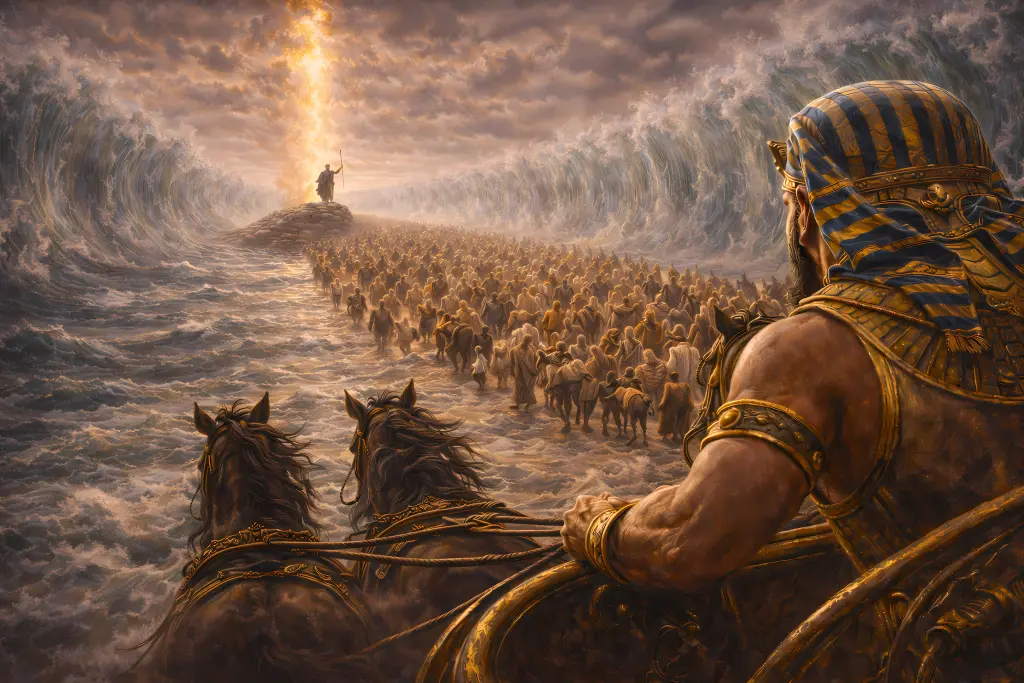
Deliverance from Egypt (Chapters 1–18): Israel multiplies in Egypt but is enslaved by a Pharaoh who does not know Joseph. Moses is born, rescued from the Nile, raised in Pharaoh’s household, flees to Midian, and is called by God at the burning bush. After a series of ten plagues culminating in the death of the firstborn and the institution of Passover, the Israelites depart. God parts the Red Sea, destroys the Egyptian army, and provides manna, water, and guidance through the wilderness as the people journey toward Sinai.
Covenant and Tabernacle at Sinai (Chapters 19–40): At Mount Sinai God appears in power, gives the Ten Commandments and the covenant law, and the people pledge obedience. While Moses receives detailed instructions for the Tabernacle, the people construct and worship a golden calf. After judgment and intercession the covenant is renewed. The final chapters describe the building of the Tabernacle, its furnishings, the priesthood, and the sacrificial system. The book closes with the glory of the Lord filling the completed Tabernacle, signifying God’s presence in the midst of His people.
Key Themes: Divine deliverance and redemption from bondage, the establishment of covenant relationship, the holiness and presence of God among His people, the giving of the Law, and the formation of Israel as a nation belonging to Yahweh. Famous elements include the burning bush, the ten plagues, the Passover, the parting of the Red Sea, the Ten Commandments, the golden calf, and the Tabernacle.
Statistics, Authorship, and Dates
Statistics (common figures from English translations like KJV/ESV/NAB; Hebrew Masoretic counts are comparable but vary slightly by manuscript/edition):
Chapters: 40
Verses: 1,213
Words: ~26,000–32,000 (English); Hebrew word counts are lower.
Authorship and Dates
Traditional view (supported by Jewish and Christian tradition, internal references such as Exodus 17:14; 24:4–7; 34:27, and New Testament allusions1): Moses is the author, writing during the wilderness period after the Exodus (~1440–1400 BC).
Modern scholarly consensus (Documentary Hypothesis): Exodus is a composite work drawing from multiple sources/traditions (often labeled J/Yahwist, E/Elohist, and P/Priestly), compiled into final form likely during or after the Babylonian exile (~6th–5th century BC), with the process reaching completion in the Persian period (~5th–4th century BC).
The narrative itself spans roughly from the late patriarchal period in Egypt through the wilderness journey to Sinai (traditionally dated either ~1446 BC for the Exodus event or, on the later chronological view, the 13th century BC).
- an indirect or passing reference to a well-known person, place, event, or text, relying on shared knowledge to add meaning ↩︎